London computer recycling, e-waste and charity technology reuse
LCR Charity manages booking and business requests easily.
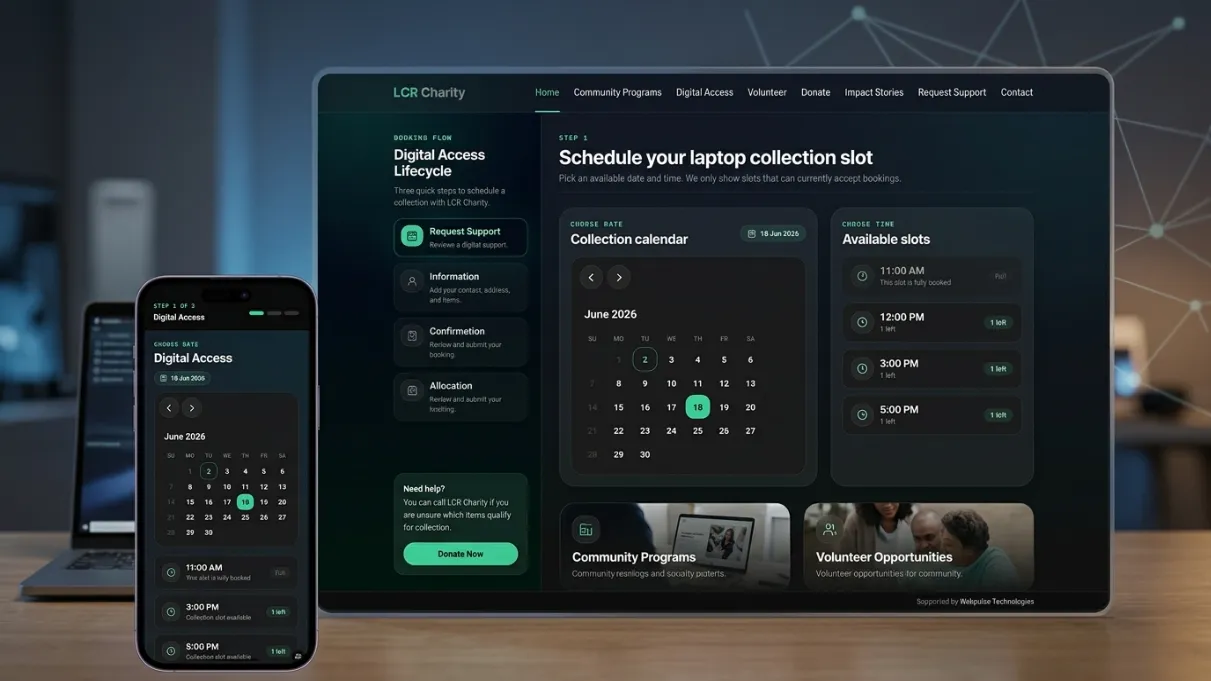
Webpulse rebuilt LCR Charity’s WordPress website into a custom computer recycling and collection request system, giving the charity a clearer public website, stronger booking flow and better admin control over residential, commercial, donation and volunteer enquiries.
- Client
- LCR Charity
- Sector
- Computer recycling and e-waste charity
- Build
- Website rebuild, booking flow and admin system
- Stack
- Next.js, Tailwind CSS, Supabase, SendGrid and Twilio
Live project
lcrcharity.co.ukBuilt with
Next.js
Tailwind CSS
Supabase
SendGrid
From collection request to admin control.
01
Request
02
Collection
03
Admin
04
Confirmation
The brief
The problem
LCR Charity recycles, refurbishes, donates and sells computer equipment, including laptops, PCs, peripherals and related IT items. The charity supports both residential and commercial users, so the website needed to help very different visitors take the right next step.
The previous website was built in WordPress and relied on third-party plugins for important booking and request workflows. That made the process harder to control in-house and limited how much visibility the team had over collection requests, donation enquiries, refurbished computer requests, volunteer interest and general contact.
The work
Webpulse solution
Webpulse took over the website and rebuilt it as a custom system using Next.js, Tailwind CSS and Supabase, with SendGrid and Twilio supporting the communication layer for booking and request workflows.
The new platform gives LCR Charity a clearer public website, a more effective booking process and an admin-controlled workflow for managing recycling collections, donations, refurbished computer requests, volunteer enquiries and general contact.
Instead of relying on a restricted plugin setup, the charity now has an in-house system that is easier to manage, easier to scale and better aligned with the way the organisation works day to day.
What had to work
The business challenge
- Replace a WordPress and plugin-led setup with a more controlled custom system.
- Make it easier for people and businesses to request computer recycling collections.
- Support both residential and commercial e-waste enquiries.
- Give visitors clear routes for donations, refurbished device requests, volunteer enquiries and general contact.
- Give the admin team better insight into incoming bookings and requests.
- Create a stronger foundation that could support a native app in the future if the charity scales further.
Delivered
The main parts of the build.
- Custom website rebuild
- Computer recycling collection requests
- Residential enquiry routes
- Commercial enquiry routes
- Donation enquiry flow
- Refurbished device request pathway
- Volunteer enquiry route
- Booking confirmation support
- Admin dashboard access
- Email and SMS communication support
User experience
UX and design thinking
The main UX challenge was making several different journeys feel simple. A resident donating an old laptop, a business arranging a larger recycling collection, a volunteer offering support and someone asking about refurbished computers all need different information.
The rebuilt journey gives users clearer routes based on what they need: collection, donation, refurbished devices, volunteering or contact. That makes the website warmer and easier to use, while still supporting the operational detail behind each request.
The admin experience was treated as part of the product, not an afterthought. Better public forms only work if the team behind the charity can see, manage and respond to requests with more confidence.
Outcome
Outcome
LCR Charity now has a more controlled digital system for managing computer recycling enquiries, collection requests, donations, refurbished computer requests, volunteer enquiries and general contact.
The rebuild moved the charity away from a restricted WordPress and third-party plugin setup into a custom platform with clearer booking journeys and better admin visibility.
The system also gives the charity a stronger base for future growth, including the possibility of a native app if the service expands further.
Need to replace a limited WordPress or plugin-based workflow?
Webpulse can help you rebuild your website, booking process or admin workflow into a clearer custom system that is easier for your team and visitors to use.